


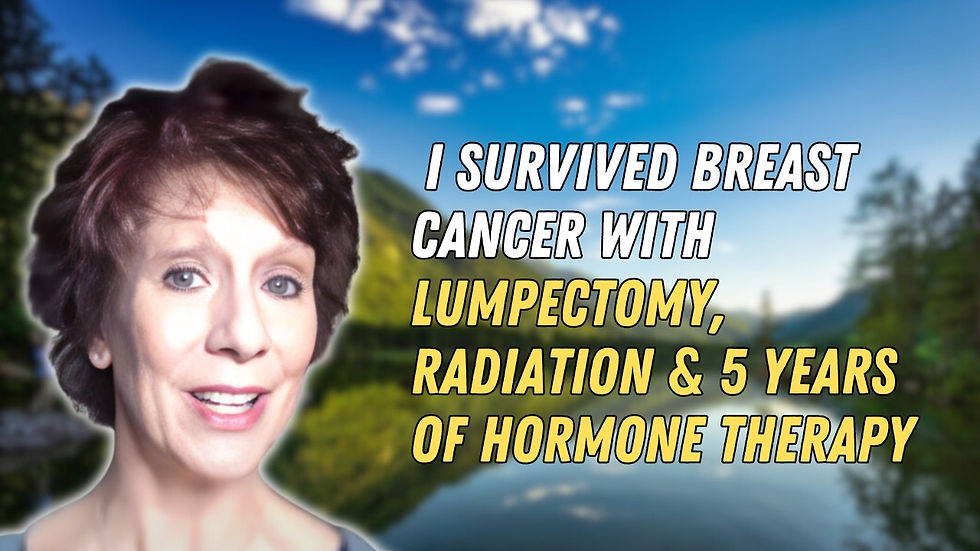
It was after a lumpectomy with radiation that Cathy Leman survived breast cancer.
- Jul 4, 2022
- 17 min read
DESCRIPTION
Cathy Leman’s breast cancer journey did not begin with something she noticed, but something noticed during her annual wellness visit to her general practitioner. Cathy’s GP asked Cathy if she felt anything out of the ordinary, and she said she didn’t; but the following morning when getting out of the shower, she said she felt like she had ice running through her veins. Cathy went back to her general practitioner and that began a series of events that led to her cancer diagnosis.
Originally from central Illinois, Cathy eventually moved to Chicago, where she makes her home. She works hard at assisting the breast cancer survivorship community, and shares her story with the @CancerInterviews podcast.
Cathy Leman’s cancer was non-aggressive, it was low-grade, Stage One and not in her lymph nodes. That said, she had one clearcut option, and that a lumpectomy with radiation and five years of hormone therapy medication.
The news of her diagnosis was difficult to deal with because Cathy was extremely fit. Not long before this horrific news, she had run the Chicago Half-Marathon.
That said, Cathy said she never felt like she was under cancer’s thumb. She was so angry about the diagnosis, and felt that nothing could penetrate her anger. Her scans and lab results were so good that she was extremely confident she would get to survivorship. In that spirit, she started a blog called Dammad About Breast Cancer.
At the time of her diagnosis, Cathy had a private practice as a dietician therapist. Her professional life had been devoted to nutrition and fitness and lifestyle behavior to reduce the risk of illness and keep people out of the hospital. Not long after her diagnosis, she decided to blend her expertise as a trainer with what she learned in her cancer journey. She soon discovered that thre were a lot of gaps in the breast cancer community in terms of education and information she thought she could fill. This led to establishing a foundation called Health Rebuild.
While in any cancer setting, early detection is key, Cathy thinks that sometime lost in the shuffle is getting in front of cancer through sound dietary practices. This called on both sides of her brain, the side familiar with life before cancer and the side that now knew about life after a cancer diagnosis. She puts a priority on optimizing outcomes through treatment, supporting recovery, and then long term health over the course of survivorship.
The mission of the foundation, Health Rebuild, is a three-legged stool.
The first leg is “Rebuild Your Health.” It stresses the importance of diet and exercise. Cathy says maintaining a good regimen at the table and at the gym is at the very foundation of rebuilding one’s health.
The next leg is “Calm Your Anxiety.” In Cathy’s private practice, she dealt with a lot of people who had eating disorders. She is fascinated by the connection between food and mood, and notes that breast cancer can often trigger eating habits that can lead to additional anxiety. Cathy says managing anxiety with self care and an awareness of how thoughts can impact one’s behavior, those are all connected.
The final leg is “Do What’s Best.” Cathy says the things one does on a day-to-day basis can have a giant impact on the trajectory of one’s cancer journey. She says to remember what makes you feel good, such as getting enough sleep, limiting screen time, and eating the foods that make you feel good instead of those which make you feel uncomfortable, all these things are very important.
Additional Resources:
Support Group: Health Rebuild https://www.cathyleman.com
Cathy’s Blog: https://www.dammadaboutbreastcancer.com
TRANSCRIPT
Bruce Morton: Greetings and welcome to the @CancerInterviews podcast. I’m your host, Bruce Morton. You know, once one survives a cancer journey, another one begins. On this episode, we are going to hear from a woman with a wealth of information on how one can optimize their survivorship through sound dietary practices. She is Cathy Leman of Chicago, Illinois, and Cathy, welcome to Cancer Interviews.
Cathy Leman: Thank you so much, Bruce. It is good to be here with you.
BM: And we are happy to have you. We begin our interviews from the same place, that being our desire to learn more about you, exclusive of your involvement with cancer, so, if you would tell us a bit about where you are from, what you do for work, and when time allows, what you do for fun.
CL: I am originally from central Illinois, but I migrated north to Chicago many years ago. My roots are in the center of the state, but I reside up north. We have really terrible weather, so we have that. I also work a lot. I work hard to assist my breast cancer survivorship community. That takes a lot of my time, but when I am not doing that, I love to cook. I am a fitness fanatic. It’s how I manage stress and sort through things in my mind. I love to read, and I am learning how to play the banjo, which is really tricky because I am a lefty. So, everything is backwards and upside down. I have a left-handed banjo, so I am working on that and that’s fun.
BM: We are going to get into the enormous piece that is part of your life, that of assisting others by way of being a dietician and a personal trainer, but before all that, you went on a cancer journey of your own when you were diagnosed with breast cancer. So, at what point did you notice something was wrong, something that needed medical attention?
CL: Actually, I did not notice it. I was at my annual wellness visit and my general practitioner, and she noticed. So, it was something I overlooked.
BM: And what happened after your GP noticed it?
CL: She brought it to my attention and asked if what she noticed felt normal to me. I told her I didn’t know. I left and got dressed, went to work, worked all day, came home, didn’t really think about it again until the next morning when I got out of the shower, and I wondered what she was talking about. Then I saw what she was referencing and I felt like ice was running through my veins. Then we were off to the races with the followup to that.
BM: Different cancers present people with different treatment options. Did you have treatment options, and if so, what were they?
CL: I have to deal with a lot of options. Gratefully, my pathology was really good, and my cancer was non-aggressive, it was low-grade, it was not in my lymph nodes, and Stage One. I also had no family history, which is common for breast cancer. I essentially had one option because it was a pretty straightforward cancer, but I did get a second opinion just for my own peace of mind. It was pretty straightforward. I had a lumpectomy with radiation, then five years of hormone therapy medication.
BM: And what would you say was the toughest part of that journey?
CL: All of it, but I would say the most difficult part was twofold. One was coming face to face with the reality of it because it just didn’t fit for me on any level. I was super fit. I had just run the Chicago Half-Marathon seven weeks before my diagnosis, was as healthy as I could be. The other side was telling my family. That was tough because I don’t live near my immediate family, so I don’t see them regularly, making that a difficult conversation.
BM: Your family. How did it figure into your cancer journey as a source of support?
CL: My family is pretty much all in central Illinois and some of them are in other areas of the other country. My husband’s family is here in the Chicago area. I had support from everyone. It was just varying levels of support, based on geography, and friends, of course; but I was really private about my breast cancer, so I didn’t share it with many people at all.
BM: Early detection certainly helped, I suspect, in your cancer journey. That said, there must have been a time in which you felt you were starting to get the upper hand on cancer. What did that feel like?
CL: I never felt like cancer had the upper hand. This may sound odd, but I was not one of those breast cancer patients who thought I was going to die. I was just so angry about the whole thing that I thought nothing can penetrate this anger. I don’t normally lead from anger. It was one of the reasons for the blog I write called Dammad About Breast Cancer. I didn’t feel like cancer had the upper hand, partly because my pathology was so good and every time I got the results of biopsy and my scans and my lab results, all of them were so favorable that it bolstered my faith in the thought that I was going to be okay getting through it.
BM: You are a dietician, you are a personal trainer. What inspired you to meld those skills with your cancer journey?
CL: At the time of my diagnosis, I was running my business called NutriFit. I had had my business since just before 2000, and I was in private practice as a dietician therapist. I had a private training studio and a staff of trainers working with me and I did corporate wellness education for businesses around the Chicago area and beyond; so, my entire career was devoted to nutrition and fitness and lifestyle behavior to reduce risk of illness, to keep people out of the hospital, preventive tactics managing medical conditions with nutrition and lifestyle, so that was always my focus. That’s exactly what I was doing at the time of my diagnosis, since I continued to run my business for a few more years. Then through a succession of changes in the brick and mortar of my training studios, I just thought of how I could help and use my professional experience and blend it with my personal experience to help other women who had gone through what I had gone through because I just started to peek around in the world of breast cancer, which was not my world of course, and I noticed there were a lot of gaps in that community, education-wise and information-wise that I could fill with my knowledge and my experience. I was really fortunate before I headed into my treatment. I called one of my dietician friends who had worked in oncology, told her what was going on and asked if she could sit down with me because I knew enough to know what I didn’t know and I wanted to make sure I was on track with what I was thinking in terms of my nutritional care while I was going through treatment, and not everyone has that available to them. I also felt that being able to help other women who help me make cancer make sense to me. It was also a way to sort of start to heal psychologically on so many other levels, so, it has been a slow but pretty straightforward with a few detours, transition.
BM: You had this foundation for this great idea called Health Rebuild, but now you had to act on it. What items were on your bucket list?
CL: Initially, with Health Rebuild, I wondered how it was going to look. I had a thriving business, I sort of crashed and burned the business without having a solid plan to move into. I started writing the blog, the Dammad About Breast Cancer blog, and started writing about the issues I saw women with breast cancer talking about on social media. I started creating some programs about breast cancer nutrition for women who are newly diagnosed to help them get prepared to get into treatment. I really just sort of tried a few things, and essentially through doing that, through trial and error, it really helped me start to formulate where I could best serve, and it is really a work in progress, putting Health Rebuild together to start getting it out into the world. It is really based on just huge gaps that I see in the survivorship space for support in terms of health and lifestyle from a nutrition standpoint.
BM: If I am hearing you correctly, all of us involved with cancer will stress the importance of early detection, but it sounds like getting out in front of cancer from a dietary standpoint can help as well. Is that fair to say?
CL: Yes, and I had to hesitate a moment because I kind of work from both sides of my brain. I say the sides of my brain are the sides representing before cancer and after cancer. Before cancer I was working with many clients who didn’t have cancer. I am not an oncology dietician, I am lifestyle dietician, and now in this space in which you should take care of yourself with nutrition and physical activity and self-care practices. Cancer or no, and with all types of cancer, people can benefit by taking the best care of themselves. I say that because the one caveat to that you can eat the healthiest diet on the planet and there is no guarantee that you won’t get cancer; what we say in the nutrition oncology world is optimizing outcomes through treatment, supporting recovery and then, long term health over the course of survivorship. That’s really the focus and it’s never a bad idea to take the best care of yourself that you can.
BM: Your platform, Health Rebuild, if you were to identify its top goals, what would they be?
CL: Well, it’s a survivorship program that helps women move forward with courage and clarity and confidence in their nutrition lifestyle choices. That for after treatment of hormone-driven breast cancer. I specialize in that area because that was the cancer I had, it’s what most women have, it’s the most common type, and there are some nuances to that I am very comfortable with. The goal of that for these women who have gone through that, they are terrified of food, they don’t trust their bodies to the level of physical activity they were at prior to cancer, and they are just not sure how to take charge of their health in order to move into a healthy survivorship, so the goal is to help them conquer that food fear so that they can eat without stress and anxiety guilt. It is also to help them regain their energy and get to doing the things they like with the people they love. It is also to help them take charge and rebuild their health so that they can feel confident that they are doing everything that they can to be as healthy as possible. There is no guarantee about recurrence, and that’s the biggest fear for anyone who has had cancer, especially in the breast cancer world. The fear of another breast cancer is terrifying, so the low-hanging fruit is to grab on to the diet. I shouldn’t eat this, or I should have had that and that becomes a little bit of an obsession. There is nothing you can do that won’t prevent that, but you can always meet it halfway. The goal of Health Rebuild is to help make women feel that they are meeting that risk halfway, and then it gives them that peace of mind that they have done what they can do.
BM: In doing a little research about Health Rebuild, I noticed three key areas you seek to address, and I want to go over each one and give you a chance to elaborate on each one. The first one is “Rebuild Your Health.”
CL: Nutrition and fitness, I always say they are two sides of the same coin. They are also part of the foundation of what rebuilds your health. Cancer is a cellular disease, metabolic disease at the cellular level. Nutrition is a science and I always like to remind people that science is not an opinion. I mean, you can have an opinion about broccoli, but that is not the science of broccoli, and so, nutrition science is really looking at how food works in our body to support health or minimize our health. Rebuilding your health I always say, starts in the kitchen, starts with your fork, your knife, your plate, and it starts at your gym or your stationary bike or your treadmill or walking outside, it’s really about those two things; but combined with mindset and mindfulness and getting momentum to get started and keep going and a maintenance level so you continue lifelong, that is what I call the foundation of rebuilding your health. You look at your nutrition, you look at your fitness, and you need these other pieces to support that.
BM: Cathy, you have established some connective tissue between physical health that comes with diet and exercise and one’s mental health, but one of your other touchstones is “Calm Your Anxiety.” Could you elaborate on that, please?
CL: Cancer is all about anxiety, and so in my previous work when I was running my private practice, I did a lot of eating disorder work, unhealthy relationships with food. I was so fascinated by that, that I went back and got my graduate degree in Health Psychology because I love the connection of food and mood and the reasons we eat, reasons that have nothing to do with hunger. The anxiety that comes from breast cancer can often trigger using food or exercise in ways that may seem helpful in calming anxiety, but they are really not. It is really about figuring out triggers and how triggers in your life, and not using exercise, fitness, food and diet as ways to cope. So, managing anxiety with mindfulness, self care, really being intentional and aware of what your thoughts are and how that impacts your behavior, those are all connected, and it is just such a critical piece to managing all of that.
BM: The third item that I noticed with Health Rebuild is something that sounds so simple and yet may be so complex, and that is “Do What’s Best.”
CL: It is simple, but it is not easy. If you can, all of the things that you do on a day-to-day basis that make you feel your best, stuff like getting enough sleep, drinking enough water, limiting how much screen time you have, getting to bed on time, getting physical activity, eating food that makes you feel good rather than food that makes you feel uncomfortable, avoiding eating to excess, all of those things that make us feel the best are not always the easiest things to do. Even a couple things you do each that make you feel good can be difficult to do. So, it is really about learning the daily actions and behaviors and habits, what I call the daily rebuild habits, learning which ones make you feel optimal and figuring out how to make those be a consistent part of your life regardless of what’s going on, whether you are traveling, whether you are having a sick or a celebration or a holiday, how are you managing that? We are really good at one week being on target, eating food that makes us feel great, and that something happens that makes us abandon all that and we have to start all over. We tend to be all or nothing, so it is really about doing what’s best, identifying it, making it work for you in a sustainable way. Everybody can anything for a day or two, but can you take good care of yourself lifelong? That’s always the challenge.
BM: You had talked about a certain of food, whether somebody thinks it is good or bad. Yours is an opinion, but it is a learned opinion, so in your learned opinion, what are some foods you think are good and bad?
CL: I am really picky about this. and this has always been my focus, when we put food in a good/bad category, it puts us in a good/bad category. So, when we say we are eating good food today, or I was bad yesterday because I ate French fries, that makes French fries bad and French fries are neutral, but it is what we make them mean that sometimes doesn’t make them seem so good in our brain. That’s why I like to take those good/bad labels and put those to the side, and ask what is the food you love to eat that loves you back? You know if you sit down in front of the TV or at the movies with an enormous bag of some kind of snack and you eat the whole thing without paying attention, that food, you probably love it but it is not loving you back because you feel not so great after you have engaged in that habit. So, it is not about avoiding any foods, it is about paying attention to how much you are having, how often and why you are eating it. Having said that, there are some recommendations for the healthiest, most optimal diet for breast health and any other health, and that’s plant-based food, eating food that is close to its original, natural, whole self as you can, and really just focusing on that. It is really easy to grab food and go, or eat oversized portions, so it is really about being intentional and staying focused and see what works best for you.
BM: We hear the term every once in a while, “Love yourself.” This sounds like a variation of “Love yourself.”
CL: I would ask, “Don’t you deserve to eat the food that makes you feel the best?” Move your body regularly, give yourself enough sleep, keep yourself hydrated. I worked with clients in the past who take better care of their animals than they do themselves. I work mostly with women and women are not always so great at self-care. They will take care of their pets and their family before they take care of themselves. There is a lot of mindset around taking good care of yourself, even recognizing that you deserve it and knowing that your health is valuable. That’s a lot of the work I do, and women needs to realize, they can’t take care of anyone else if they don’t take care of themselves.
BM: Before we go any farther, Cathy, we would like for people to know how to access the work you do; so, if you would, give us the address for your website and your blog.
CL: You can find me at my Health Rebuild website, which is cathyleman.com. I am on Instagram, that is where I am most active any handle there is hormone.breastcancer.dietician, and my blog is its URL, it’s dammadaboutbreastcancer.com.
BM: Finally, Cathy, we begin our interviews from the same place and end them at the same place. Namely, if you encountered somebody one-on-one who was just beginning a journey with breast cancer or any other cancer, and you had message for that person, if there was one overarching point you would like to make, what would it be?
CL: I would stress that they will get through the experience of breast cancer. They’ll get through it. Secondly, I would stress there is a continuum of breast cancer diagnosis, there’s that initial diagnosis time, there’s that treatment time and there’s that post-treatment time. Within that continuum how you feel in your body, in your mind, is going to shift. Even for someone diagnosed with metastatic breast cancer, things will ebb and flow. Just be patient with yourself, give yourself grace and recognize that the only way to go through it is to go through it. You can’t avoid the reality like I tried to do because that will not serve you.
BM: Wonderful. Cathy, thanks so much, we had mentioned at the top that would bring a wealth of information, and that you have done. Cathy, thanks again.
CL: Thank you so much, Bruce, it was my pleasure.
BM: And that is going to wrap up this edition of Cancer Interviews. We want to remind you as you make your way down a cancer journey or if you know somebody who is, you are not alone. There are people like Cathy out there who have an abundance of information that can help you through. So, until next time, we’ll see you on down the road.
Support Group: Health Rebuild
Cathy on Instagram:
Cathy’s Blog:
SHOW NOTES
TITLE: Cathy Leman, MA, RD, Dietician/Trainer, Breast Cancer Survivor – Chicago, Illinois, USA
Cathy Leman was a dietician and personal trainer when she was diagnosed with breast cancer. Upon surviving breast cancer, she decided to redirect her career path in a manner that melded her dietician and training expertise with her survivorship. The result was Health Rebuild, a platform that seeks to optimize one’s cancer survivorship through sound dietary practices.
Additional Resources:
Support Group: Health Rebuild www.cathyleman.com
Cathy on Instagram: www.hormone.breastcancer.dietician
Time Stamps:
04:09 When diagnosed with breast cancer, Cathy underwent a lumpectomy with radiation.
08:06 Opted to combine her experience of her cancer journey with her skills as a dietician and trainer.
11:40 Cathy sought to close existing information gaps regarding nutrition for women with breast cancer.
16:09 Describes the goal of her platform, Health Rebuild.
23:15 Cathy wants you to ask if the food you love, loves you back.
25:30 Says women with breast cancer first taking care of their dietary health best positions them to take care of the dietary health of loved ones.
KEYWORDS (tags):
cancer
lumpectomy
cancer bootcamp
cathy leman
radiation treatment
breast cancer
cancer survival checklist
hormone therapy
bruce morton
cancer cure
Comments