


Bethany Smith has survived lymphoma and thyroid cancer | bleomycin | vinblastine | levothyroxine
DESCRIPTION
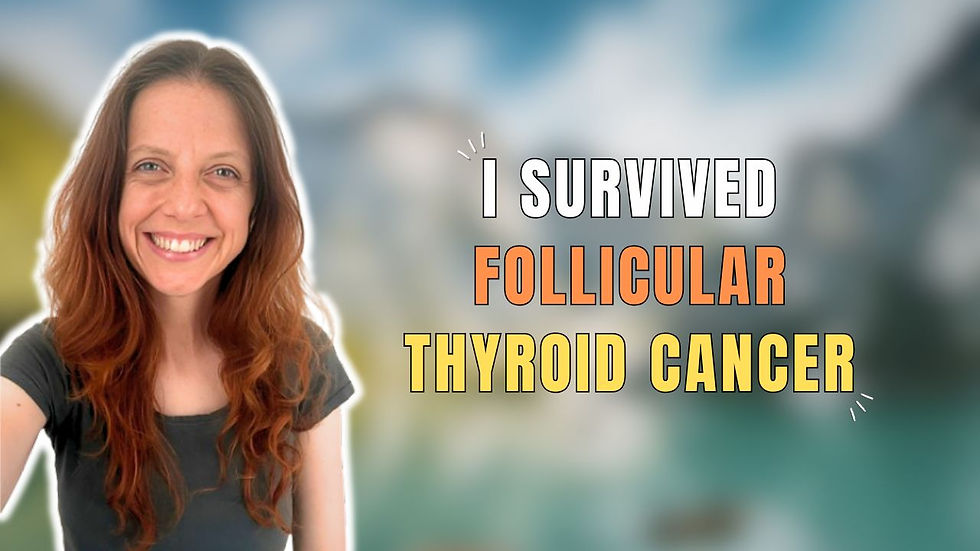
Bethany Smith is a fighter. Almost immediately after surviving Hodgkin lymphoma, she was diagnosed with metastatic follicular thyroid cancer. In addition to having her thyroid removed, she also underwent total hip replacement. All this while raising three small children. Treatment of her lymphoma included a chemotherapy regimen of adriamycin, bleomycin, vinblastine and dacarbzin. Her treatment for thyroid cancer featured radioactive iodine. Bethany credits oxygen therapy for helping her to become free of thyroid cancer and these maintains her health with levothyroxine.
Bethany cannot tell you exactly when she first detected in the vicinity of her thyroid. It had been there for years when her mother visited, saw the lump and insisted she seek medical attention. This led to a series of scans and the discovery of a second lump near her clavicle. A biopsy of the lump on her collarbone resulted in a diagnosis of Hodgkin lymphoma in the Autumn of 2022, while the biopsy of the lump on her thyroid came back as “indeterminant.” Bethany’s care team said it would turn its attention to the thyroid lump after addressing her lymphoma diagnosis.
She was placed on a six-month regimen of ABVD chemotherapy, which included adriamycin, bleomycin, vinblastine and dacarbazine. Bethany suffered many of the usual side effects tied to chemo, including fatigue, nausea and hair loss. The latter forced her to cut her hair short and then the purchase of a half dozen wigs of different colors.
Bethany attained survivorship from Hodgkin lymphoma, but halfway through her chemo, she underwent a PET scan, which showed two lesions, one on her C5 vertebrae and one on hip. She underwent a biopsy on the lump on her thyroid in the Spring of 2023, which not only indicated follicular thyroid cancer, but that it had metastasized to the bones in her vertebrae and right hip.
Bethany had to undergo a thyroidectomy and because was eating away at her right hip, it, too, had to be removed. In September 2023, she began a three-dose regimen of radioactive iodine, which forced her to be kept in isolation. She was given another CT scan that revealed that cancer was in twelve places in her bones.
Bethany said the pain of her hip replacement exceeded that of three times giving birth without painkillers. She says she is able to walk just fine these days, walking that includes her love for hiking, and her lack of a thyroid is successfully addressed with levothyroxine, which replaces the hormones lost when her thyroid was removed.
Bethany Smith has experienced the physical toll of her two cancer journeys, but then and now, she deals with everything that has come her way with her natural and boundless sense of optimism.
Additional Resources:
Bethany’s app: https://www.stillcancercompanion.com
Bethany’s YouTube channel: Bethany Smith Cancer
TRANSCRIPT
Bruce Morton: Greetings. This is the @CancerInterviews podcast. I’m your host, prostate cancer survivor Bruce Morton. Our guest on this episode is a fighter. Bethany Smith of Surrey, United Kingdom first survived Hodgkin lymphoma, then overcame a diagnosis of follicular thyroid cancer, a journey that included a total hip replacement. But we are very happy to report she is here to tell her story and now is the time to hear it. Bethany, welcome to Cancer Interviews.
Bethany Smith: It is an absolute pleasure to be here. Thank you for having me.
Bruce: Before we learn about your cancer journey, we would like to hear about your life away from cancer. If you would, tell us about where you are from, what you have done for work and what you like to do for fun.
Bethany: I am Bethany Smith, 42 years young, and I am married to a lovely man, Louis. I have three gorgeous, active children. Before I was diagnosed, I was a midwife for twelve years and absolutely adored that job. It was a dream job. For fun, I love to be with people. I volunteer at my local church, I help with refugees, I volunteer at the local school, I love to hike whether it is rivers or mountains or beaches. Anything in nature makes me very happy.
Bruce: For all of us who have been diagnosed with cancer, there was that point in time when our health went from seeming normal to seeming abnormal first with Hodgkin lymphoma. For you, when did you initially notice that wasn’t quite right?
Bethany: This is one of my key takeaways. Please do not ignore lumps. I am ashamed to say I noticed a lump on my thyroid two to three years before I went to the doctors. In the summer of 2022 when my mother came to visit and she noticed a lump on my throat. I told her it was fine and that it had been there for a while. I didn’t have symptoms, I didn’t feel ill and it wasn’t causing me problems. Life is busy, so I just haven’t had time to go to the doctor. Bless my mother. She is a bossy, goodhearted woman. She said she wasn’t leaving the house until I booked an appointment with a doctor. Ultimately, that is what did it, a lump that my mother noticed, because in terms of symptoms, I felt good and well. I was exhausted a lot, but I had three small children, I worked twelve-hour shifts as a midwife. At the time, the children were one, three and five, so they were still waking up at night, and I assumed the exhaustion was from my children. I was falling asleep by like 7:00pm, so in retrospect was probably too exhausted.
Bruce: So, you did not seek medical attention as quickly as your mother would have liked, but eventually you did seek it, and that led to a diagnosis. What was the chain of events that led to your diagnosis?
Bethany: Here in the NHS, we get free health care, and I am incredibly grateful for that. The day I called up, the GP saw me the same day. Then two weeks later he scheduled me for an ultrasound. They did an ultrasound on my neck, and at the time, he asked me if I had any other lumps. I said I don’t think so, but I checked and felt one on my collarbone. A lump the size of a golf ball popped up and he said it was a bit bigger than they would like it to be, so I was sent for an MRI, so two weeks later, I went in for that. According to its results, my tissue didn’t look normal, so they wanted to send me back for an ultrasound but this time with a biopsy. It had the news that changed my life. They said the biopsy of the lump on my collarbone showed I had Hodgkin lymphoma. As for the lump in my neck, on my thyroid, they said the biopsy came back “indeterminant,” meaning they didn’t know if it was or was not cancerous. They decided to treat my cancerous lump with chemo and re-evaluate the lump on my neck after the first lump has been addressed.
Bruce: By the way, we hope you will find the time to like and subscribe to our channel. And if you click on the bell icon, you will be notified any time we post an interview. We also want to remind you that Cancer Interviews is not a distributor of medical advice. If you seek medical advice, please contact a licensed health care professional.
So, now you have gotten this diagnosis. Were you optimistic about survivorship?
Bethany: I am thankfully a very optimistic person. However, at this point, I had not been to hospital since I was three years old. I was devastated and incredibly worried. I foolishly went to Google and started Googling and was worried that cancer might shorten my life. I wear my heart on my sleeve and within a few days I went on Facebook and said I had been diagnosed with Hodgkin lymphoma. If anyone has been diagnosed with this, please let me know because I want to hear positivity. Thankfully, within a week I heard stories from five different people saying they had had Hodgkin lymphoma, had been treated and were completely cured, including one friend who said both their mother and their mother-in-law, both above sixty at the time had had Hodgkin lymphoma and were completely cured. So, while I was terrified about the effects of treatment for my cancer, I was also reassured from the people who reached out and said that I would be fine. At that point in time, I panicked but was also optimistic.
Bruce: But you were on a chemo regimen and chemotherapy is never pleasant. If you would, describe the regimen and what was its toughest part?
Bethany: The specific chemotherapy I was on was known was ABVD chemotherapy, which stands for adriamycin, bleomycin, vinblastine and dacarbazine. It included six cycles for six months. What happened was every two weeks I would go in and I would have a four-hour stint in hospital where I had a PICC line in my arm and they would inject me with the chemotherapy medication with the steroids and the anti-nausea medication. My husband and I would try to find the funny in everything we did along this journey. Without fail I would fall asleep and he would have to half-drag me to the car and I would fall asleep after getting home. After getting the chemotherapy, I felt like a 95-year-old granny. Within 24 hours of this dose, I would be exhausted, I would feel a little bit nauseous, I would feel wobbly, I would feel weak. The chemotherapy would increase my anxiety. Within a week of the chemotherapy I would start to feel better, but always feel weak and wobbly. Within two doses of chemotherapy, my hair started falling out. I was told I wouldn’t go completely bald like others on a chemo regimen, but within two months it was so thin and straggly that I didn’t feel comfortable keeping my hair. Physically, it was a huge, but I was not prepared for the emotional and mental part of it. There were a lot of tears and a lot of anger.
Bruce: How difficult was it to go from sadness to gladness?
Bethany: Personally, I believe in Jesus and decided to read and record the New Testament. So, each week read the chapter about Jesus lifting Peter from the sea when I was mentally drowning. I caught COVID and flu during chemotherapy and almost ended up in intensive care and those were the weeks that I read about Jesus healing others. I allowed myself to get sad and cry, but I could refocus myself and concentrate on faith. This helped me to stay happy and healthy for my kids and my husband.
Bruce: Where the lymphoma was concerned, you were eventually able to attain survivorship. What was that like?
Bethany: It was very joyous time. It was actually quite bittersweet because about four months in I had a PET scan. After the fourth of the six doses of chemotherapy I went in for the PET scan and the results of that PET scan showed I had a lesion on my C5 vertebrae and on my right hip. While it showed no Hodgkin lymphoma, it showed I had lesions on my spine and my hip. I was joyful the Hodgkin was gone, then very worried because they showed problems with my bones, and at that point, they sent me for a biopsy on my hip. They tried to reassure me that it was arthritis or osteoporosis, but sought a biopsy nonetheless. So, I had very mixed emotions.
Bruce: At that point, I am guessing you could have been at a mental and emotional crossroads. You could have been devastated at the prospect of dealing with cancer a second time, or you could have been emboldened by the thought that you had survived cancer and felt you could do it again. Which option did you choose?
Bethany: That’s a great question. I will be completely candid. When that biopsy came back, that was probably among the worst days of my life. At that point I thought I was in the clear with Hodgkin lymphoma. My husband had gone on holiday with some friends between two doses of chemo. At that time, my managed to contract norovirus from my kids, so I was vomiting. So, I was incredibly nauseous and my husband was away, my kids were recovering from the virus. That’s when I got a call from the doctor saying the lesions are metastatic thyroid cancer, so not only did I have thyroid cancer, but it had metastasized to my bones. I have never felt so low in my life as that day. I called my husband on holiday and told him he had to come because I had just received a second diagnosis of cancer and it is far worse. I cried all that day and when my husband came, I snuggled with him, cried and shouted at the heavens. I was taught not to swear but that day I shouted expletives. Doctors told me this was incurable and they cannot commit to more than three to five years for me to live. They said when it gets to your bones, it is considered incurable because once its there, you cannot get it out. So, rather than getting on my happy and hopeful pedestal, it took me about a week to get over my sadness and anger and frustration. My blessed husband who I will adore forever just stood by me and hugged me and allowed me to come to terms with having a second and worse cancer. I did find out that with thyroid cancer there would be no chemotherapy, which was sort of a silver lining, that there would be other treatments for this.
Bruce: And among those other treatments is radioactive iodine, which is part of the regimen for many diagnosed with thyroid cancer. Viewers and listeners diagnosed with thyroid cancer might want to know what they look forward to if they are prescribed radioactive iodine.
Bethany: It’s funny to state it that way in terms of what patients can look forward to, but having three little kids, the one silver lining, the one thing I could look forward to was the utter quiet and peace because you are isolated from the world and you are not allowed visitors for four days, so it was a time to isolate and to meditate. But first, Bruce, I will rewind just a touch because I still had one dosage of chemotherapy left. I was diagnosed around Easter of 2023, and there were multiple things that happened in the five months before I got to that point. So, when I had one dosage of chemotherapy left, doctors were really keen that I have a thyroidectomy, but they couldn’t do that unless my immune system was high. So, in those two weeks I did a lot of visualizations and meditation, and praying, hoping that my immune system would come back up again. Two days before my thyroidectomy my immune system was still too low and I said to myself I have two days to get my immune system back up or else it is not safe to have the surgery. In those two days I sent out messages asking people to pray for me. Two days later my immune system was within the boundary of being safe for a thyroidectomy. So, I went in and had my full thyroid out. Then four weeks later after getting my thyroid removed, as you mentioned, I had a full hip replacement. So, they took the bone out completely and replaced it completely. Then four weeks after that, while I am recovering from hip replacement, I then had a full week of radiotherapy. The problem was, they told me, was that the lesion in my vertebrae was so large, they said if I had the radioactive iodine before the radiotherapy, there was a risk of the vertebrae rupturing. They didn’t want to rupture my vertebrae. First I went for two weeks of radiotherapy, and symptomatically it was much better than chemotherapy. I had a dry mouth and a sore hip, but it wasn’t too bad at all. Six weeks later, they let me recover and allowed me to go on holiday with my family, including seven siblings, which was wonderful because I was still very worried about my longevity. Doctors said I could go on the trip before starting up with radioactive iodine. I was not allowed to eat anything with iodine in it, so things like eggs and seafood, I had to cut out for seafood, I had to cut out for two weeks. The thing with your thyroid is that it loves iodine, it mops up iodine. They wanted to cut out any iodine so that when I went to hospital had a radioactive tablet that meant they any thyroid cancer cells in my body want to consume the iodine. I then went into hospital on they put me in an isolation room, checked all my vitals to may sure I was completely fit and healthy. Then they gave me a radioactive tablet. It looks like any sort of normal drug, but it comes in this lead line box, and they put it into the tube, they pass it over to you and you swallow this tablet. My children, bless them, said as was being radioactive, wanted to know if I would be like Spiderman. I said, “I wish I could come back as a superhuman.” Thankfully, my children couldn’t see me. By way of advice, I would suggest to anyone in my position at that time to make sure and video call your children because not being able to hug and cuddle and kiss your kids or your husband, that was probably the hardest symptom for me. Radioactive iodine made me tired, but obviously it was the mental thought was what happens if this doesn’t work that was toughest.
Bruce: Next up. Two-part question for you. What was life like without a hip?
Bethany: I am now a bionic woman. The first four weeks were an utter hell. I have had three labors without any pain relief, and women might not thank me for this, but the two weeks after hip replacement were way worse than any labor. Yes, labor pain is intense and giving literal birth to a baby is intense, but you know at the end of it you are going to get a baby, and there are breaks between contractions. Hip replacement means constant pain and for me it was really intense. They didn’t give me enough pain relief to begin with. I had to go back to them for my pain relief, and it meant not being able to sleep on my back for the first four weeks and I am a side sleeper. I had to walk with crutches for a good six weeks I think it was, but in the leadup, I was told that if I didn’t have hip replacement, I would have to be in a wheelchair because the cancer had eaten up my bone so much I wouldn’t be able to walk anymore. It was difficult before and was difficult afterwards. To anyone getting bone replacement, I recommend oxygen therapy because it was able to bend my knee and bend my hip properly and accelerated the healing process after my hip replacement. Now I am normal, so I can use it like any sort of normal hip.
Bruce: The second part of this two-part question is, what is life like without a thyroid?
Bethany: That’s a good question. People might wonder what does a thyroid do? It is just a little lump on your neck, but the thyroid is really essential to your health. It regulates your hormones. It helps to regulate your metabolism. It helps to regulate your energy. So, life without a thyroid means I take levothyroxine, it’s a drug replacement for your body’s natural thyroid hormone. So, really, not much difference except that I will be on a lifelong journey with levothyroxine. I have to take it in the morning. If I forget one day, I might accidentally double-dose, which I don’t want to do, because if I double-dose, I get a splitting headache, but if I miss a dose, I notice in the next 24 hours that I am more tired. So, life without a thyroid is not dreadful because of modern medicine.
Bruce: We are about to wrap up, but before we do, Bethany, you have ways of helping others, including an app. Why don’t you tell us about it?
Bethany: I realized there are plenty of cancer apps that focus on the medical part, tracking of symptoms or wellness apps out there, which help you to visualize, but there are no apps that bring those two things together, and so I decided to create an app with the principals I have used in the last 18 months, three years, really, to amplify what the medical system is doing. You can find by going to https://www.stillcancercompanion.com or you can go to YouTube and check out my channel, Bethany Smith Cancer. My app wants to send the message that you can empower your health while getting treated medically, to amplify what the doctors are doing.
Bruce: And we want to remind anyone watching or listening that we will have Bethany’s app information included in the Description and/or Show Notes. And with that Bethany, we are going to bring this episode to a close. Thank you so much for a powerful story that can provide information and information. Bethany, thanks for being with us on Cancer Interviews.
Bethany: My absolute. Wonderful to meet you, wonderful to chat with you.
Bruce: And we want to remind you as we always do when we conclude, that you or a loved one are on a cancer journey or you think you might be on one, that you are not alone. There are individuals out there like Bethany Smith, who have words of wisdom that can ease the cancer journey, So, until next time, we’ll see you on down the road.
Additional Resources:
Bethany’s app: https://www,stillcancercompanion.com
Bethany’s YouTube channel: Bethany Smith Cancer
SHOW NOTES
TITLE: Bethany Smith, Lymphoma & Thyroid Cancer Survivor – Surrey, United Kingdom
Bethany Smith is a fighter. Almost immediately after surviving Hodgkin lymphoma, she was diagnosed with metastatic follicular thyroid cancer. In addition to having her thyroid removed, she also underwent total hip replacement. All this while raising three small children. Treatment of her lymphoma included a chemotherapy regimen of adriamycin, bleomycin, vinblastine and dacarbzin. Her treatment for thyroid cancer featured radioactive iodine. Bethany credits oxygen therapy for helping her to become free of thyroid cancer and these maintains her health with levothyroxine.
Additional Resources:
Bethany’s App: https://www.stillcancercompanion.com
Bethany’s YouTube Channel: Bethany Smith Cancer
Time Stamps:
01:47 Bethany noticed a lump on her throat years before she sought medical attention.
04:18 A Biopsy revealed she had Hodgkin lymphoma.
06:56 Describes her chemotherapy regimen.
12:10 Bethany recalls achieving survivorship from Hodgkin lymphoma.
13:37 Her reaction to her diagnosis of thyroid cancer.
17:03 Describes being treated with radioactive iodine.
18:58 Recalls hip replacement.
23:23 Bethany describes living without a hip.
25:30 Says this is what it’s like being with a thyroid.
KEYWORDS (tags):
follicular thyroid cancer
thyroidectomy
hodgkin lymphoma
adriamycin
doxorubicin
bleomycin
vinblastine
dacarbazine
osteoperosis
radioactive iodine
oxygen therapy
levothyroxine
Comments